what p40 group moved from north africa to england in june 1944 to fly p47
| 325th Operations Group | |
|---|---|
 43d Fighter Squadron F-22 Raptor with a group F-15 Eagle[note one] | |
| Agile | 1942–1945, 1947–1952, 1955–1960, 1991–present |
| Country |  U.s. U.s. |
| Branch |  United States Air Strength United States Air Strength |
| Role | Fighter |
| Function of | Air Combat Command Ninth Air Strength 325th Fighter Wing |
| Garrison/HQ | Tyndall Air Strength Base |
| Nickname(s) | Checkertail Association (World War 2)[1] |
| Motto(s) | Locare et Liquidare Latin Locate and Liquidate (1951-present) Consilium Conficitur Plan - Contest (World War II)[1] |
| Engagements | World War II Mediterranean Theater of Operations |
| Decorations | Distinguished Unit Citation Air Force Outstanding Unit Accolade |
| Insignia | |
| 325th Operations Grouping emblem[note 2] [2] |  |
| 325th Fighter Group keepsake (World War II)[one] |  |
The 325th Operations Group is the flight component of the 325th Fighter Fly, assigned to Air Combat Command of the United States Air Force . The group is stationed at Tyndall Air Forcefulness Base, Florida. Information technology conducts preparation on the Lockheed Martin F-22 Raptor and commands one operational Raptor squadron. Information technology directs the flying and support operations of 2 F-22 squadrons, a fighter preparation squadron, an operations back up squadron and a preparation support squadron.
The group was first activated in August 1942 as the 325th Fighter Group at Mitchel Field, New York. After grooming at Hillsgrove Army Air Field, Rhode Island, the group moved to North Africa in 1943, where it flew combat missions with the Curtiss P-40 Warhawk, earning a Distinguished Unit Commendation for actions over Sardinia for engaging a superior force of enemy shipping and destroying more than one-half of them. The grouping was withdrawn from combat in the fall of 1943 and re-equipped with the Republic P-47 Thunderbolt. After moving to Italia, the group re-entered combat, earning a 2d Distinguished Unit Citation in January 1944. The group continued in combat until VE Day, returning to the Usa in the fall for inactivation.
The 325th was again activated in 1947 as an all-weather fighter unit, moving late in the twelvemonth to Hamilton Air Force Base. California. It assumed responsibleness for air defense of the northern Pacific coast after moving to Moses Lake Air Force Base, Washington. With the beginning of the Korean War, a number of Air National Guard units were activated, one of which was fastened to the group. In December 1951, the group dispatched one of its squadrons to Korea to provide all-weather air defence for the Seoul region. However, Air Defense Command (ADC) was finding that the single grouping and wing organization did not fit its model of dispersed fighter squadrons. Accordingly, information technology replaced its fighter wings and groups with regionally oriented defence force wings and inactivated the group in February 1952.
In 1955, ADC implemented Project Arrow, which replaced its Air Defense Groups organized in the early 1950s with fighter groups that had been active during World War Ii. The 325th was activated once once again at McChord Air Force Base of operations, Washington to replace the 567th Air Defense Group, whose personnel, equipment and mission it assumed. The following year, the 325th Fighter Wing was again activated, and until 1957 the group was a paper organisation, used to staff various wing offices. It was inactivated in 1960, with its sole remaining squadron assigned directly to the 325th Wing.
The 325th remained in inactive condition until 1991 when information technology was again activated as the 325th Operations Group.
Assigned units [edit]
The 325th Operations Grouping commands three flying squadrons and two support squadrons.
- 2d Fighter Training Squadron "American Beagle Squadron"
- The 2nd Fighter Training Squadron was reactivated in Baronial 2014 to operate Northrop T-38 Talons and behave adversary training for F-22 Raptor pilots flight air superiority missions.[three]
- 43d Fighter Squadron "American Hornets" (Diagonals on tails)
- The 43d Fighter Squadron was the first squadron to receive the Lockheed Martin F-22 Raptor and is the only Raptor training squadron.[iv]
- 95th Fighter Squadron "Mr. Basic"
- The 95th Fighter Squadron activated in Oct 2013 as an operational F-22A Raptor Squadron.[5]
- 325th Grooming Support Squadron "Blackness Bears"
- The 325th Training Support Squadron manages grooming resources and conducts bookish and simulator grooming for F-22 pilots, air boxing managers and intelligence officers.[6]
- 325th Operations Support Squadron
- The 325th Operations Support Squadron supports F-22 Raptor pilots. The squadron controls all air traffic at Tyndall, manages the airfield complex, and provides weather observation and forecasting. The squadron likewise provides operations, weapons and tactics, life support and water survival training and scheduling.[7]
History [edit]
Globe War Two [edit]
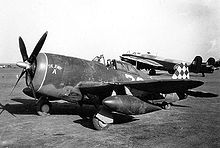
325th Fighter Group P-47 at an Centrolineal airfield in Italy
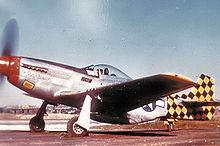
325th Fighter Group P-51D Mustang
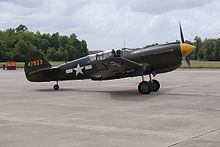
The 325th was commencement activated as the 325th Fighter Group at Mitchel Field, New York in Baronial 1942 with the 317th,[8] 318th,[nine] and 319th Fighter Squadrons[10] assigned. It trained at Hillsgrove Ground forces Air Field with Curtiss P-40 Warhawk aircraft[11] before moving to North Africa by ship and send planes in January through Feb 1943. The group entered combat in April 1943 and began escorting medium bombers, flight strafing missions, and conducting body of water sweeps from bases in Algeria and Tunisia.[11] The 325th participated in the defeat of Axis forces in Tunisia, the reduction of Pantelleria, and the conquest of Sicily.[11] The 325th received a Distinguished Unit of measurement Citation (DUC) for action over Sardinia on 30 July 1943 when the group, using diversionary tactics, forced a superior number of enemy planes into the air and destroyed more than half of them.[11] The group did not wing combat missions from the end of September to mid-December 1943 every bit the 325th converted to Commonwealth P-47 Thunderbolt aircraft and moved to Italy.[11]
The 325th began operations with Fifteenth Air Forcefulness in December 1943, and primarily engaged in bomber escort operations.[eleven] Information technology received a second DUC for a mission on 30 January 1944 when the group flew more than than 300 miles at very depression altitude to surprise the enemy fighters that were defending German airfields near Villaorba, Italy; by severely dissentious the enemy's force, the 325th enabled heavy bombers to strike vital targets in the surface area without encountering serious opposition.[eleven] The group converted to North American P-51 Mustang aircraft in May 1944 and provided the fighter escort on the start shuttle bombing mission from Italian republic to Russian federation in early June 1944, and became the first American grouping to score a victory while flying from a Russian base.[12] It escorted heavy bombers during long-range missions to assail the Messerschmitt factory at Regensburg, the Daimler-Benz tank factory at Berlin, oil refineries at Vienna, and other targets, such as airfields, marshalling yards, and communications targets in Italy, French republic, Germany, Czechoslovakia, Austria, Hungary, Romania, and Yugoslavia. It also covered operations of reconnaissance shipping and strafed such targets as trains, vehicles, and airfields. The grouping continued gainsay operations until May 1945.[eleven] The group moved back to the U.S. and was inactivated after V-E Twenty-four hours.[11]
325th Ftr Gp Aerial Victories
| Aerial Victories | Number | Note |
|---|---|---|
| Group Hq | nineteen | [xiii] |
| 317th Fighter Squadron | 209 | [xiv] |
| 318th Fighter Squadron | 173 | [xv] |
| 319th Fighter Squadron | 119 | [16] |
| Grouping Total | 520 |
Common cold State of war [edit]
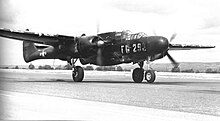
318th Fighter Squadron P-61B[note 3]
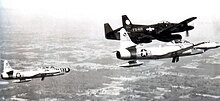
325th Fighter Group F-94 Starfires and F-82 Twin Mustang
The group was inactive from 1945 until 1947, when it was activated as an all-weather fighter group equipped with Northrop P-61 Black Widows.[11] In 1948, the grouping converted to North American F-82 Twin Mustang aircraft[11] and moved to Washington, to provide air defense for the Atomic Energy Commission Hanford Plant.[17] In 1948, the U.s.a. Air Force unified operational and support organizations under a unmarried fly nether what is called the Hobson Plan. Equally a issue, the 325th Fighter Wing became the parent for the 325th Grouping and three other supporting groups[eighteen]
Beginning in Jump 1949, it conducted the All Weather Combat Coiffure Training School, while participating in air defense operations, exercises and training.[two] In 1951, equally ADC expanded its mission, the Federalized 123d Fighter-Interceptor Squadron, flying Earth War 2 era F-51Ds, was attached to the group (now named the 325th Fighter-Interceptor Group).[19] Although the 123d received some day fighter North American F-86 Sabres in July, information technology continued to fly Mustangs while attached to the 325th.[19] Meanwhile, the other three squadrons of the 325th converted from their Twin Mustangs to early model Lockheed F-94 Starfires in June and December 1951.[20]
In December 1951, 5th Air Force, engaged in the Korean State of war, indicated to Headquarters, United States Air Force that it needed all-conditions interceptors to defend the Seoul surface area. In response, ADC dispatched the group'southward 319th Fighter-Interceptor Squadron to Suwon Air Base of operations, although the squadron remained assigned to the 325th grouping.[21] The 325th group and wing inactivated in February 1952[eleven] as role of a major Air Defence force Command (ADC) reorganization that replaced its fighter wings with regional air defence force wings, responding to ADC'south difficulty nether the existing wing base organizational construction in deploying fighter squadrons to best advantage.[22] Its operational squadrons were transferred to the 4704th Defense Wing at McChord Air Force Base and the 4703d Defense Wing at Larson Air Force Base, Washington.[23]

F-102s of the grouping'due south 318th FIS in 1958
In 1955 the personnel and equipment of the inactivating 567th Air Defense Group,[24] including the 317th Fighter-Interceptor Squadron[8] were transferred to the newly designated 325th Fighter Grouping (Air Defence force),[xi] which activated once again at McChord as result of ADC's Project Arrow, which was designed to bring back on the active list the fighter units which had compiled memorable records in the ii globe wars.[25] Because one purpose of Projection Arrow was to reunite fighter squadrons with their traditional groups,[25] the 318th Fighter-Interceptor Squadron was moved from Presque Isle Air Force Base of operations.[9] to assume the personnel and equipment of the 567th'due south 465th Fighter-Interceptor Squadron.[26] Both of the group's squadrons flew the radar equipped and rocket armed F-86D version of the Sabre.[20] The 325th served as the USAF "host" grouping at McChord Air Force Base until October 1956, when the 325th Fighter Wing was reactivated[ii] and was assigned several support organizations to fulfill its duties.[27] [28] [29] At the same fourth dimension it conducted air defense operations.[2]
The group became subordinate to the 325th Fighter Fly once more in October 1956 and was not-operational as all group headquarters personnel were used to human the wing headquarters until nigh June 1957.[2] The squadrons upgraded to Convair F-102 Delta Daggers, the 317th Squadron in December 1956 and the 318th in March 1957.[20] In August 1957, the 317th Squadron moved to Alaska and was reassigned from the group,[8] while the 64th Fighter-Interceptor Squadron simultaneously moved from Alaska to McChord.[xxx] The grouping regained control over its tactical squadrons in June 1957 and continued air defense operations of the fly, with annual squadron deployments to Tyndall Air Force Base, Florida for firing practice.[two] Only before the group was discontinued, the 64th Squadron moved to Paine Field, Washington, where it was reassigned to the 326th Fighter Group.[thirty] The group was in the procedure of converting to Convair F-106 Delta Darts[xx] when information technology was discontinued in March 1960, with its remaining tactical squadron being transferred directly to 325th Fighter Fly control.[ii]
Reactivation [edit]

McDonnell Douglas F-15D Eagle, 325th Operations Grouping
On one September 1991, the grouping was redesignated the 325th Operations Group and activated when the 325th Fighter Fly implemented the USAF Objective Wing organization.[ii] The 325th Group was assigned control of the wing's tactical units.[2] The group was originally part of Tactical Air Control, but in an Air Force realignment of advanced coiffure training responsibilities, it transferred to Air Education and Training Command in June 1992. The group mission was to train McDonnell Douglas F-15 Eagle pilots. It continued this mission until 2010, calculation F-22 Raptor grooming in 2003. When F-fifteen training ended, the group was reduced to a single flying squadron.[two] The group also conducted battle direction training through its 325th Air Command Squadron. This mission ended in October 2012 and transferred to the 33d Operations Group.[31]
In October 2012, the Air Force combined both combat and training F-22 Raptor squadrons into a unmarried grouping, and realigned the grouping nether Air Gainsay Command.[32]
Lineage [edit]
- Constituted as the 325th Fighter Group on 24 June 1942
- Activated on iii Baronial 1942
- Inactivated on 28 October 1945
- Redesignated 325th Fighter Group (All Weather) on 2 May 1947
- Activated on 21 May 1947
- Redesignated: 325th Fighter Group, All Weather, on 10 May 1948
- Redesignated: 325th Fighter-All Weather condition Grouping on 20 January 1950
- Redesignated: 325th Fighter-Interceptor Group on ane May 1951
- Inactivated on vi February 1952
- Redesignated 325th Fighter Grouping (Air Defence force) on 20 June 1955
- Activated on 18 August 1955
- Discontinued on 25 March 1960[notation 4]
- Redesignated 325th Tactical Training Group on 31 July 1985 (remained inactive)
- Redesignated 325th Operations Grouping on ane September 1991
- Activated on i September 1991.[33]
Assignments [edit]
|
|
Components [edit]
| Operational Squadrons
| Back up Units
|
Stations [edit]
|
|
Aircraft [edit]
- P-40 Warhawk, 1942–1943
- P-47 Thunderbolt, 1943–1944)
- P-51D Mustang, 1944–1945, 1951–1952
- P-61 Blackness Widow, 1947–1948
- F-82 Twin Mustang, 1948–1951
- F-94A Starfire, 1950–1952
- F-86E Sabre, 1951
- F-86D Sabre, 1955–1957
- F-102 Delta Dagger, 1956–1960
- F-106 Delta Dart, 1960
- McDonnell Douglas F-15 Eagle, 1991–2010
- Lockheed Martin F-22 Raptor, 2003 – present[33]
Awards and campaigns [edit]
| Award streamer | Honour | Dates | Notes |
|---|---|---|---|
 | Distinguished Unit Commendation | thirty July 1943 | Sardinia, 325th Fighter Group[xi] |
| | Distinguished Unit Citation | 30 January 1944 | Italy, 325th Fighter Group[eleven] |
 | Air Force Outstanding Unit Laurels | 1 July 1993–30 June 1995 | 355th Operations Group[two] |
| | Air Force Outstanding Unit of measurement Honour | i July 1995–30 June 1996 | 355th Operations Group[ii] |
| | Air Force Outstanding Unit Award | i July 1996–30 June 1997 | 355th Operations Grouping[2] |
| | Air Force Outstanding Unit Honour | i July 1997–30 June 1999 | 355th Operations Group[2] |
| | Air Force Outstanding Unit Honour | 1 July 1999–30 June 2001 | 355th Operations Group[two] |
| | Air Forcefulness Outstanding Unit Honour | 1 July 2001–xxx June 2002 | 355th Operations Group[two] |
| | Air Force Outstanding Unit Laurels | 1 July 2002–thirty June 2004 | 355th Operations Grouping[2] |
| | Air Force Outstanding Unit Laurels | 1 July 2004–30 June 2005 | 355th Operations Group[2] |
| | Air Strength Outstanding Unit Award | 1 July 2005–30 June 2006 | 355th Operations Group[2] |
| | Air Forcefulness Outstanding Unit Award | i July 2006–xxx June 2007 | 355th Operations Grouping[2] |
| | Air Force Outstanding Unit of measurement Award | ane July 2008–thirty June 2009 | 355th Operations Group[2] |
| Campaign Streamer | Entrada | Dates | Notes |
|---|---|---|---|
 | American Theater without inscription | 3 Baronial 1942 – seven February 1946 | 325th Fighter Group |
 | Tunisia | 28 Feb 1943 – 13 May 1943 | 325th Fighter Grouping[11] |
| | Sicily | 14 May 1943 – 17 August 1943 | 325th Fighter Grouping[11] |
| | Naples-Foggia | 18 August 1943 – 21 January 1944 | 325th Fighter Group[xi] |
| | Rome-Arno | 22 January 1944 – ix September 1944 | 325th Fighter Group[11] |
| | Southern France | fifteen August 1944 – xiv September 1944 | 325th Fighter Group[11] |
| | Due north Apennines | 10 September 1944 – four April 1945 | 325th Fighter Group[11] |
| | Central Europe | 22 March 1944 – 21 May 1945 | 325th Fighter Group[xi] |
| | Po Valley | 3 April 1945 – 8 May 1945 | 325th Fighter Grouping[11] |
| | Air Combat, EAME Theater | 28 February 1943 – xi May 1945 | 325th Fighter Group[11] |
| | Normandy | half-dozen June 1944 – 24 July 1944 | 325th Fighter Grouping[xi] |
| | Northern France | 25 July 1944 – 14 September 1944 | 325th Fighter Grouping[11] |
| | Rhineland | fifteen September 1944 – 21 March 1945 | 325th Fighter Group[eleven] |
| | Air Offensive, Europe | 28 February 1943 – v June 1944 | 325th Fighter Grouping[eleven] |
See besides [edit]
- List of F-86 Sabre units
- F-94 Starfire units of the U.s. Air Forcefulness
- List of F-106 Delta Dart units of the United States Air Force
- List of F-xv operators
References [edit]
Notes [edit]
- Explanatory notes
- ^ Aircraft in foreground is Lockheed Martin F/A-22A LRIP Lot ii Block 10 Raptor 02-2029.
- ^ Approved 1 Oct 1951.
- ^ Aircraft is P-61B-20-NO Black Widow serial 43-8293 at Hamilton Field
- ^ The group is non related to a 325th Fighter Group (Air Defence force), Conditional that was organized at McChord on ane Nov 1960 and discontinued on 1 Feb 1961. run across Cornett & Johnson, p. 78.
- Citations
- ^ a b c Watkins, p. forty
- ^ a b c d eastward f g h i j g 50 m north o p q r s t u Kane, Robert B. (fourteen January 2011). "Factsheet 325 Operations Group (AETC)". Air Strength Historical Research Agency. Retrieved 23 May 2012.
- ^ Olwell, Chris (21 August 2014). "'Beagles' to be reactivated". Panama City News Herald . Retrieved 30 April 2015.
- ^ "Factsheet 43rd Fighter Squadron". Tyndall AFB Public Affairs. 17 Dec 2013. Archived from the original on 9 June 2011. Retrieved 29 April 2015.
- ^ "Factsheet 95th Fighter Squadron". Tyndall AFB Public Affairs. 26 Nov 2014. Retrieved 29 Apr 2015.
- ^ "Factsheet 325th Training Back up Squadron". Tyndall AFB Public Diplomacy. 4 December 2014. Retrieved 29 April 2015.
- ^ a b "Factsheet 325th Operations Back up Squadron". Tyndall AFB Public Affairs. 26 July 2013. Retrieved 29 Apr 2015.
- ^ a b c d Maurer, pp. 386–387
- ^ a b c Maurer, Gainsay Squadrons, pp. 388-389
- ^ Maurer, Gainsay Squadrons, pp. 390-391
- ^ a b c d e f one thousand h i j yard l m n o p q r south t u v w ten y z aa ab Maurer, Combat Units, pp. 206–208
- ^ Abstract, History of 325th Fighter Group, June 1944]. Retrieved 24 May 2012 "Abstract, History 325 Fighter Group Jun 19144". Air Force History Index. Retrieved 24 May 2012.
- ^ Newton & Senning, p. 599
- ^ Newton & Senning, pp. 594-596
- ^ Newton & Senning, pp. 597-598
- ^ Newton & Senning, pp. 598-599
- ^ "Abstruse, History 325 Fighter Group(AW) Jul-Dec 1948". Air Strength History Index. Retrieved 24 May 2012.
- ^ Ravenstein, p. 10
- ^ a b Cornett & Johnson, p. 122
- ^ a b c d Cornett & Johnson, p. 125
- ^ Endicott, p. 65
- ^ Grant, p. 33
- ^ Cornett & Johnson, p. 66
- ^ Cornett & Johnson, p. 85
- ^ a b Buss, et al., p.vi
- ^ Maurer, Combat Squadrons, pp. 571-572
- ^ a b c d e Cornett & Johnson, p. 138
- ^ a b Cornett & Johnson, p. 151
- ^ a b Abstract, History of 325th USAF Hospital, Jul-Dec 1955 Archived thirteen December 2013 at the Wayback Machine. Retrieved 23 May 2012
- ^ a b Maurer, Combat Squadrons, p. 244
- ^ a b Elsea, SSG Rachelle (5 September 2012). "325th ACS to remain under AETC". 325th Fighter Wing Public Affairs. Retrieved 3 July 2015.
- ^ Elsea, SSG Rachelle (4 Oct 2012). "325th FW reassigned to ACC in ceremony". 325th Fighter Wing Public Affairs. Retrieved ane May 2015.
- ^ a b c d Lineage, including assignments, components, stations and shipping in Kane, AFHRA Factsheet 325 Operations Grouping, except as noted.
- ^ "Factsheet 1 Fighter Squadron". Air Force Historical Research Agency. 2 Jan 2008. Retrieved 23 May 2012.
- ^ "Factsheet, 1st Fighter Squadron (Inactivated December 15, 2006)". 325th Fighter Fly Public Affairs. eighteen December 2006. Retrieved 1 July 2015.
- ^ Bailey, Carl Eastward. (17 March 2015). "Factsheet 2 Fighter Squadron". Air Force Historical Research Bureau. Archived from the original on vii August 2016. Retrieved 28 April 2015.
- ^ Bailey, Carl E. (16 March 2015). "Factsheet 43 Fighter Squadron (AETC)". Air Force Historical Research Agency. Archived from the original on 4 March 2016. Retrieved 28 Apr 2015.
- ^ Robertson, Patsy (30 January 2009). "Factsheet 64 Attacker Squadron (ACC)". Air Force Historical Research Agency. Retrieved 23 May 2012.
- ^ Robertson, Patsy (xx February 2015). "Factsheet 95 Fighter Squadron". Air Forcefulness Historical Inquiry Agency. Archived from the original on 4 March 2016. Retrieved 28 Apr 2015.
- ^ Maurer, Combat Squadrons, pp. 390-391. The online copy includes a handwritten notation of the attachment of the squadron.
- ^ a b c d e See Mueller, p. 395 for a list of back up units activated in Baronial 1955 along with the group.
- ^ Warnock, A. Timothy (seven July 2009). "Factsheet 325 Air Control Squadron (AETC)". Air Forcefulness Historical Research Agency. Retrieved 25 May 2012.
- ^ Cornett & Johnson, p. 142
Bibliography [edit]
 This article incorporates public domain material from the Air Force Historical Research Agency website http://www.afhra.af.mil/.
- Buss, Lydus H.(ed), Sturm, Thomas A., Volan, Denys, and McMullen, Richard F., History of Continental Air Defense force Command and Air Defense Control July to December 1955, Directorate of Historical Services, Air Defence Command, Ent AFB, CO, (1956)
- Cornett, Lloyd H; Johnson, Mildred W (1980). A Handbook of Aerospace Defense Organization, 1946–1980 (PDF). Peterson AFB, CO: Role of History, Aerospace Defense Center.
- Endicott, Judy Thou., ed. (2001). The USAF in Korea, Campaigns, Units and Stations 1950-1953 (PDF). Maxwell AFB, AL: Air Force Historical Research Bureau. ISBN0-16-050901-7.
- Grant, C.Fifty., (1961) The Development of Continental Air Defense to 1 September 1954, USAF Historical Study No. 126
- Maurer, Maurer, ed. (1983) [1961]. Air Force Combat Units of Earth State of war Two (PDF) (reprint ed.). Washington, DC: Office of Air Force History. ISBN0-912799-02-1. LCCN 61060979.
- Maurer, Maurer, ed. (1982) [1969]. Combat Squadrons of the Air Force, Earth War 2 (PDF) (reprint ed.). Washington, DC: Office of Air Forcefulness History. ISBN0-405-12194-6. LCCN 70605402. OCLC 72556.
- Mueller, Robert (1989). Air Strength Bases, Vol. I, Active Air Forcefulness Bases Within the U.s.a. of America on 17 September 1982 (PDF). Washington, DC: Function of Air Force History. ISBN0-912799-53-6.
- Newton, Wesley P. Jr. and Senning, Calvin F., (1963) USAF Credits for the Destruction of Enemy Aircraft, World State of war Two, USAF Historical Report No. 85
- Ravenstein, Charles A. (1984). Air Strength Combat Wings, Lineage & Honors Histories 1947-1977 . Washington, DC: Function of Air Force History. ISBN0-912799-12-nine.
- Watkins, Robert A. (2009). Insignia and Aircraft Markings of the U.S. Army Air Force In World War 2. Vol. IV, European-African-Center Eastern Theater of Operations. Atglen,PA: Shiffer Publishing, Ltd. ISBN978-0-7643-3401-6.
- Further reading
- Green, Hershel H. (2000). Herky! The Memoirs of a Checkertail Ace. Atglen, PA: Schiffer Publishing, Ltd. ISBN0-7643-0073-3.
- McDowell, Ernest R. (1994). Checkertails: The 325th Fighter Group in the Second Earth State of war. Carrollton, TX: Squadron/Signal Publications, Inc. ISBN0-89747-316-7.
- McDowell, Ernest R.; Hess, William N. (1969). Checkertail Clan: The 325th Fighter Group in North Africa and Italy. Fallbrook, CA: Aero Publishers, Inc. ISBN978-0-81689-750-half-dozen.
- Rogers, Brian. (2005). Usa Air Force Unit Designations Since 1978. Hinkley, Britain: Midland Publications. ISBN1-85780-197-0.
External links [edit]
 Media related to 325th Fighter Grouping (United States Army Air Forces) at Wikimedia Commons
Source: https://en.wikipedia.org/wiki/325th_Operations_Group
0 Response to "what p40 group moved from north africa to england in june 1944 to fly p47"
Post a Comment